The bending process of a slot frame is a critical manufacturing step, essential for creating robust and precise structural components used across various industries, including automotive, construction, and specialized machinery. A slot frame, often referring to a component with specific channels, grooves, or slots cut into it for assembly or functionality, requires high-precision forming to ensure all geometric specifications, especially the angular and dimensional tolerances of the bends, are met. The process is a careful balance of material science, tooling design, and machine control.
🔩 I. Materials and Preparatory Steps
The choice of material is paramount, as it dictates the machine settings, tooling requirements, and the final mechanical properties of the bent frame.
Material Selection
Common materials for slot frames include:
-
Steel Alloys: Low-carbon (mild) steel, high-strength low-alloy (HSLA) steel, and stainless steel are widely used for their strength, weldability, and cost-effectiveness. The material’s yield strength ($\sigma_y$) and tensile strength are critical properties that determine the bending force required.
-
Aluminum Alloys: Preferred for applications where weight reduction is necessary, such as aerospace and electric vehicles. Aluminum’s lower ductility compared to steel requires more careful control to prevent cracking during bending.
Material Preparation
Before bending, the raw stock (often a blank, tube, or profile) must be prepared:
-
Cutting: The material is precisely cut to the required length and blank shape, often using laser, plasma, or high-speed saw cutting.
-
Slotting/Punching: The characteristic slots or features are typically created prior to bending. This is crucial because bending a pre-slotted part can lead to complex material deformation near the slots, potentially causing thinning, cracking, or warping. The slots must be strategically placed to account for material movement during the bend.
-
Deburring: Sharp edges and burrs created during cutting or slotting are removed to prevent damage to the tooling and to improve safety and part quality.
⚙️ II. Bending Methods and Equipment
The choice of bending method depends on the frame’s geometry, material thickness, desired accuracy, and production volume.
A. Press Brake Bending (The Most Common Method)
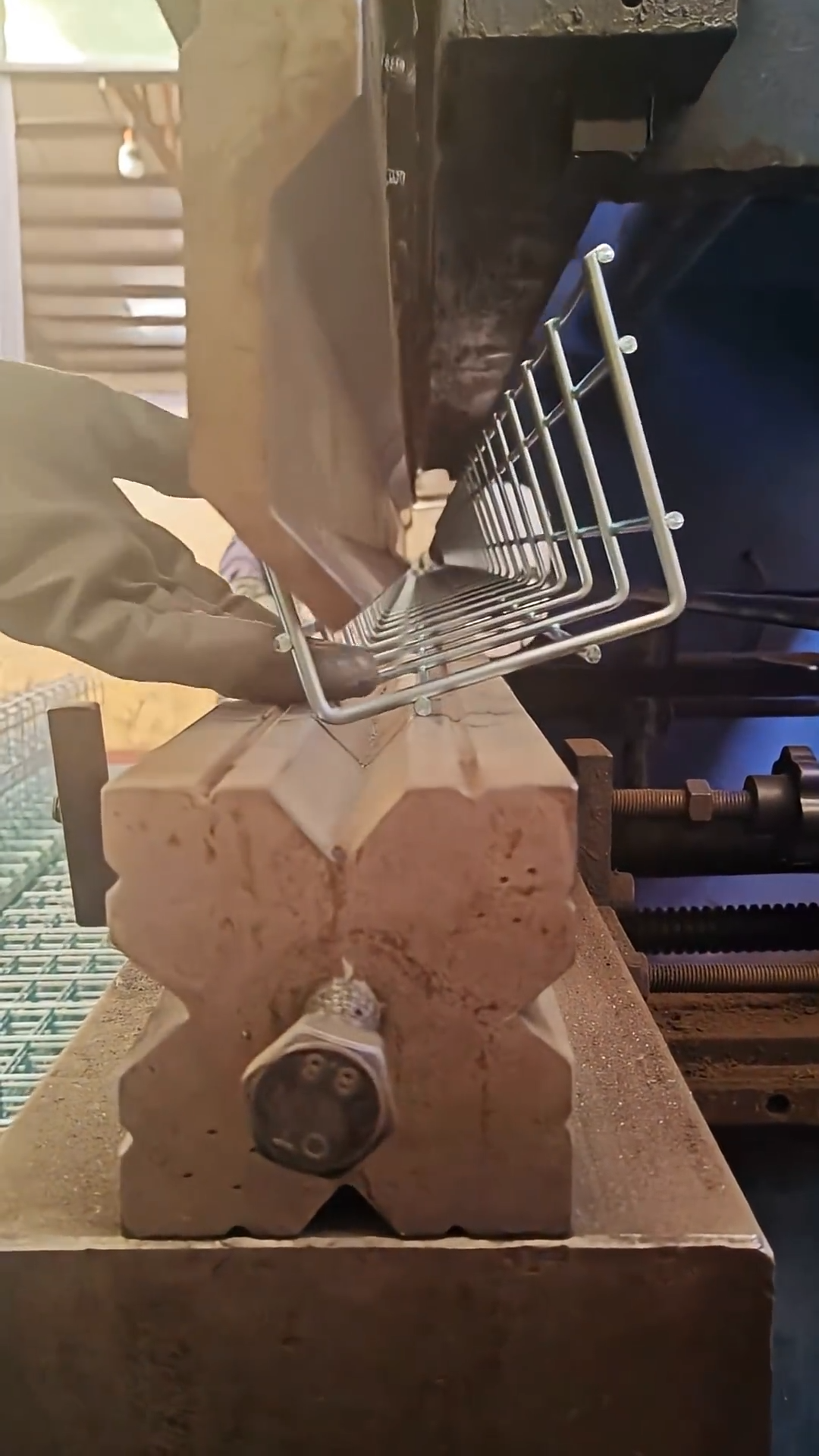
The press brake is the most common machine used for bending sheet metal slot frames. It works by pressing the workpiece between a punch (or upper die) and a V-shaped or channel-shaped die (or lower die).
Key techniques include:
1. Air Bending (Most Versatile)
In air bending, the punch forces the metal into the lower die, but it does not press the material all the way to the die’s bottom. The bend angle is determined by the depth of the punch penetration.
-
Advantages: It is highly versatile, as one set of tooling can create a range of angles ($\text{90}^\circ$ to $\text{30}^\circ$ or less) by simply adjusting the ram depth. The bending force is relatively lower.
-
Challenge: It requires a sophisticated control system (CNC) to precisely manage the ram depth to compensate for springback.
2. Bottoming
In bottoming, the material is pressed fully into the lower die cavity, matching the tooling angle. This provides a more consistent angle than air bending.
3. Coining
This is an extreme form of bottoming where a very high force is applied to thin the material at the bend radius. While it minimizes springback, it is rarely used for slot frames due to the massive forces required and the stress imparted on the material near the slots.
B. Rotary Draw Bending (For Tubes and Profiles)
If the slot frame is made from a tube or a structural profile (like a square or rectangular tube), rotary draw bending is used.
-
The tube is clamped to a form die (the bending radius) and drawn around it using a wiper die and a pressure die.
-
Mandrels (internal supports) are often inserted into the tube to prevent the inner wall from wrinkling and the cross-section from collapsing (ovality), which is a critical concern, especially near the slots.
C. Roll Bending (For Large Radii)
For frames requiring very large, sweeping curves (large radii), roll bending using three or four rolls is employed to gradually form the material.
📐 III. The Physics of Bending and Compensation
Bending is a complex metal-forming process involving elastic and plastic deformation. Understanding the physics is crucial for setting up the machine.
Neutral Axis and Bend Allowance
During bending, the material on the outside of the bend stretches and is in tension, while the material on the inside compresses and is in compression. Somewhere between these two zones lies the neutral axis, where the material length theoretically does not change.
- The Bend Allowance (BA) is the arc length of the material along the neutral axis required for the bend. This formula is critical for calculating the correct flat blank size:
$$BA = \frac{\theta}{360} \times 2 \pi (R + K \times T)$$
where $\theta$ is the bend angle (in degrees), $R$ is the inside bend radius, $ T $is the material thickness, and$ K $ is the K-factor (typically 0.33 to 0.50), which defines the position of the neutral axis.
Springback
Springback is the inherent tendency of the material to partially return to its original shape after the bending force is released. This occurs because the material is stressed beyond its yield point, but a portion of the total deformation is still elastic.
- To achieve a final desired angle ($\theta_{final}$), the material must be bent to a tighter angle, the Bent Angle ($\theta_{bent}$). The difference is the springback angle ($\Delta \theta$):
$$\Delta \theta = \theta_{bent} – \theta_{final}$$
-
In CNC press brakes, the machine calculates and applies over-bending automatically to compensate for springback based on stored material data and real-time angle measuring systems.
🧐 IV. Quality Control and Potential Defects
Maintaining high quality in slot frame bending is essential for the final product’s structural integrity and assembly fit.
Key Quality Parameters
-
Angle Accuracy: The final bend angle must be within tight tolerances (often $\pm 0.5^\circ$).
-
Dimensional Accuracy: The distance between bends and the overall frame dimensions must be correct.
-
Bend Radius: The inside bend radius must meet specifications to ensure the material is not unduly stressed.
-
Slot Distortion: The most critical check for a slot frame is that the slots near the bend zone have not warped, necked (narrowed), or deformed past tolerance.
Common Bending Defects
-
Cracking: Occurs on the outer bend surface, usually due to the material’s ductility limit being exceeded, often aggravated by sharp tooling or an incorrect bend radius (too small).
-
Wrinkling/Waviness: Common on the inner surface of the bend, especially in thinner material or near the slots, due to compression forces. This is addressed by using appropriate tooling, such as a wiper die in tube bending, or adjusting the pressure in press brake bending.
-
Warping/Canoeing: When the frame twists or bows out of plane, often a result of uneven material stresses or poor clamping/support during the bend.
-
Flashing/Burrs: Excess material that can result from worn or improperly aligned tooling.
💻 V. Automation and Future Trends
Modern slot frame bending relies heavily on sophisticated automation and control:
-
CNC Control: Computer Numerical Control (CNC) systems manage all machine parameters, including ram position, backgauge distance (for positioning the part), and tonnage.
-
Laser and Optical Sensors: Real-time angle measurement systems use lasers or cameras to measure the bend angle while the bend is in progress. The machine then adjusts the ram depth on the fly, a process known as in-process correction, virtually eliminating springback issues.
-
Robotic Loading/Unloading: Industrial robots are increasingly integrated to load blanks, position them accurately against the backgauges, and stack the finished frames, significantly improving cycle time and operator safety.
The bending process of the slot frame is a highly engineered discipline. Success hinges on selecting the right material, applying the correct tooling for the specific geometry, and precisely compensating for the material’s behavior, particularly springback and material movement around the pre-cut slots, to produce a high-quality, geometrically accurate final component.