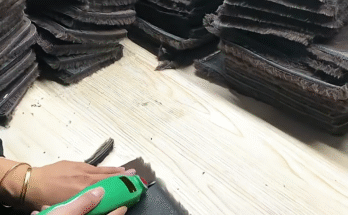
The process of creating beveled wood blocks involves making an angled cut across the edge of a piece of wood, changing the angle from the standard 90 degrees to another specific angle (e.g., $45^\circ$, $30^\circ$, or $60^\circ$). This differs from a miter cut, which is an angled cut across the face of the board. Bevels are fundamental in woodworking, used for joining pieces to create frames, molding, or for aesthetic purposes to relieve sharp edges.
🛠️ Essential Tools for Bevel Cuts
The choice of tool largely depends on the size of the block, the complexity of the cut, the required precision, and the woodworker’s available equipment. Power tools offer speed and consistency, while hand tools provide control and are often preferred for smaller, detail-oriented work.
Power Saws
The most common and efficient method for cutting beveled wood blocks involves adjusting the blade or baseplate angle on a power saw.
-
Table Saw: The blade can be tilted to the desired bevel angle (usually up to $45^\circ$ or $50^\circ$). The workpiece is then pushed through the blade, guided by the rip fence or a miter gauge. Safety is paramount on a table saw, especially when making narrow bevel cuts; a push stick or push block is essential to keep fingers away from the spinning blade. For narrow pieces, a sacrificial piece of wood can be temporarily attached to the workpiece with double-sided tape or hot glue to create a larger, safer surface area against the fence.
-
Setting the Angle: While many table saws have angle gauges, their precision can be questionable. A digital bevel gauge or an analog bevel square should be used to precisely set the blade angle relative to the table surface.
-
-
Miter Saw (Chop Saw): The blade itself can be tilted (beveled) and swung horizontally (mitered). Dual-bevel miter saws are highly convenient as they can tilt in both directions, eliminating the need to flip the workpiece for opposing bevels. The wood block is held firmly against the fence and the base, and the blade is slowly brought down to make the cut.
-
Circular Saw: For longer, larger pieces or on-site work where a table saw isn’t practical, a circular saw can be used. The saw’s baseplate can be tilted to the desired bevel angle. A straight edge, clamped securely to the workpiece, serves as a fence to guide the saw for a straight cut.
-
Band Saw: While often used for curved cuts, a band saw can be set up with a tilted fence to cut bevels along the length of a board.
Hand Tools
For intricate, small blocks or when power tools are unavailable, hand tools offer a traditional and satisfying method.
-
Hand Plane (e.g., Block Plane, Jack Plane): A sharp hand plane can be used to manually shave away material to form a bevel. The process involves marking the desired cut line on the face and edge of the block, then making successive passes with the plane, gradually working down to the line. This method offers extreme control and a very smooth finish but is labor-intensive, especially on hard woods or for deep bevels.
-
Hand Saw and Miter Box: A miter box is a simple jig that guides a handsaw (like a backsaw or dovetail saw) at fixed angles (usually $45^\circ$ and $90^\circ$). While typically used for miter cuts, an adjustable miter box or a custom jig can guide the saw to make a bevel cut on a small block.
-
Chisel: For very small blocks or for cleaning up rough cuts, a sharp chisel can be used to pare away waste material.
📝 The Step-by-Step Cutting Process
Regardless of the tool chosen, the fundamental process for cutting a precise bevel on a wood block follows a critical sequence of steps.
1. Preparation and Layout
-
Determine the Angle: Establish the exact bevel angle required for the project (e.g., $45^\circ$ for a picture frame joint where two pieces combine to form a $90^\circ$ corner).
-
Mark the Cut Line: Use a sharp pencil and a combination square or a bevel square to transfer the required angle and cut length onto the wood block. For pieces that will be joined, marking ensures proper alignment. The cut line should be clearly visible but thin enough for maximum accuracy.
-
Secure the Wood: The wood block must be firmly secured. In a table saw operation, this means the block is held against the fence and the table. When using a hand saw or circular saw, the block must be clamped securely to a stable workbench, ensuring the cut line is clear of the bench.
2. Setting the Tool Angle
-
Calibrate the Bevel: Loosen the locking mechanism on your chosen power saw (miter saw, table saw, or circular saw). Tilt the blade (table saw/miter saw) or the baseplate (circular saw) until the onboard gauge displays the target angle.
-
Verify for Precision: Always use an external, calibrated tool like a digital angle gauge or a high-quality bevel square to confirm the actual angle between the blade and the table/fence. On a table saw, the gauge is typically placed against the blade and the saw table, zeroing out the reading on the table first. Adjust the saw until the external gauge confirms the required angle.
-
Lock and Check: Securely tighten all locking mechanisms on the saw to prevent the blade angle from shifting during the cut.
3. Making the Cut
-
Test Cut: Before cutting the final piece, always perform a test cut on a piece of scrap wood of the same dimensions. This verifies the angle setting and the safety of the setup. For joining cuts (like two $45^\circ$ bevels), join the scrap pieces to ensure they form the required $90^\circ$ or other final angle.
-
Position the Workpiece: Place the wood block so the waste material falls away from the fence or the secured portion of the block. This minimizes the risk of kickback, which occurs when a small piece of wood is trapped and violently ejected by the spinning blade.
-
Execute the Cut:
-
Table Saw: Turn the saw on and let it reach full speed. Keeping the block flat on the table and pressed firmly against the fence, use a push block or stick to safely feed the block through the blade.
-
Miter Saw: Turn the saw on, ensure the blade is at full speed, and slowly bring the blade down through the wood block.
-
Circular Saw: Run the saw along the secured straight edge/fence.
-
-
Check the Final Block: Inspect the cut for smoothness, accuracy, and tear-out. If necessary, a light sanding or a final pass with a hand plane can clean up the edge.
⚠️ Safety and Advanced Techniques
Safety Protocols
Working with beveled blocks, especially on a table saw, carries unique risks due to the angle of the blade and the tendency for off-cuts to be small.
-
Kickback Prevention: Always feed the wood so the off-cut falls away from the fence, and use push blocks or sticks when the distance between the blade and fence is narrow. Never stand directly behind the blade’s path.
-
Stabilization for Small Blocks: Small blocks are inherently unstable and dangerous to cut. Whenever possible, it is safer to bevel a long piece of stock first and then cut the small blocks to final length using a miter cut. If small blocks must be beveled, use a jig or a sacrificial piece of wood secured to the block to increase the surface area for stability and a safer push.
-
Proper Blade Height: Set the blade height slightly (about one tooth) above the thickness of the workpiece for optimal cutting efficiency and safety.
Double Bevels and Compound Cuts
Many woodworking applications require more complex angles.
-
Double Bevel: Cutting two opposing bevels on the edges of a board. This is often accomplished on a table saw by cutting the first bevel, then flipping the board, adjusting the fence, and cutting the second bevel. As mentioned, for very narrow strips, it is safer to secure the narrow piece to a wider, scrap board to ensure stability and control.
-
Compound Miter/Bevel: A compound cut is a combination of a bevel (blade tilt) and a miter (blade swing). This is commonly used for crown molding or complex box joints where the cut must be angled in two dimensions simultaneously. A compound miter saw is the ideal tool for this, as it allows for simultaneous adjustment of both angles.
The cutting process of beveled wood blocks is a cornerstone skill in woodworking, demanding precision in measurement and angle setting, coupled with a disciplined approach to shop safety. Mastering this technique opens the door to creating sophisticated joints and aesthetically pleasing edges in countless woodworking projects.