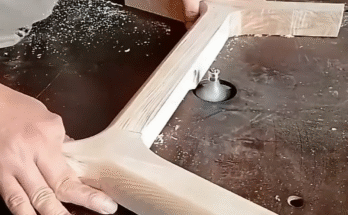
The installation of a wooden floor is a transformative project that adds warmth, elegance, and enduring value to any space. Far more than simply laying boards down, it is a meticulous process that requires careful planning, preparation, and execution to ensure a beautiful and lasting result. This guide provides a full, in-depth breakdown of the entire installation journey, from initial planning to final finishing touches.
I. 📋 Pre-Installation: Planning and Preparation
The success of a wooden floor installation is largely determined by the work completed before the first board is even laid. This critical phase involves material selection, accurate measurement, and, most importantly, preparing the environment.
A. Selection and Sourcing
The first step is selecting the type of wood flooring:
-
Solid Hardwood: Offers longevity and the ability to be refinished multiple times. It is typically installed over a wood subfloor using a nail-down method.
-
Engineered Hardwood: Features a real wood veneer atop a stable core (plywood or HDF). Its greater stability makes it suitable for installation below grade or over concrete via a glue-down or floating method.
-
Laminate/Vinyl (often wood-look): While not true wood, these floating options are easier to install and more moisture-resistant but cannot be refinished.
Once the type is chosen, calculate the required material. Measure the room’s length and width to find the square footage ($A = L \times W$). It is essential to add a waste factor, typically 5% to 10%, to account for cuts, defects, and future repairs. For complex layouts or diagonal installation, use the higher percentage.
B. Acclimation: The Crucial Waiting Period
Wood is a hygroscopic material, meaning it absorbs and releases moisture, causing it to expand and contract. If flooring is installed before it has reached equilibrium with the room’s environment, it will likely warp, gap, or buckle later. Acclimation is the mandatory process of allowing the flooring material to rest in the room where it will be installed.
-
Duration: This typically takes 3 to 7 days, depending on the environment and the wood type (follow manufacturer guidelines strictly).
-
Procedure: Keep the planks in their unopened or slightly opened boxes, stacked with spacers (stickers) to allow air circulation. The room must maintain normal living conditions, with the HVAC system running and the temperature and humidity regulated to the final expected levels (e.g., $60^{\circ}\text{F}$ to $80^{\circ}\text{F}$ and $35\%$ to $55\%$ relative humidity).
C. Subfloor Preparation
The subfloor is the foundation, and its condition is paramount. It must be clean, dry, and level.
-
Moisture Check: This is the most critical step, especially over concrete. Use a moisture meter to check the subfloor. For wood subfloors, moisture content should not exceed $12\%$ or be more than $4\%$ higher than the flooring material. For concrete, relative humidity should be below $75\%$ (check with a calcium chloride test or in-situ probe). High readings require a moisture barrier.
-
Leveling: The subfloor should be flat within $1/8$ inch over a 6-foot radius. Humps should be sanded down, and depressions filled with a leveling compound (for concrete) or shims/patches (for wood).
-
Cleanliness: Sweep, vacuum, and scrape the subfloor to ensure no debris or protruding nails interfere with the installation.
II. 🔨 The Installation Procedure
With the subfloor prepared and the wood acclimated, the actual installation can begin. The technique varies significantly based on the installation method: nail-down, glue-down, or floating.
A. Establishing the Laying Line
For a professional finish, the layout must be planned meticulously.
-
Determine Direction: Laying the boards parallel to the longest wall or perpendicular to the windows (to hide minor gaps or imperfections by following the light) is generally recommended.
-
Find the Center: Measure the room’s width and snap a chalk line down the center.
-
Establish the Starting Line: The first row sets the alignment for the entire floor. Calculate the width of the first board plus the expansion gap (typically $1/2$ inch, which is essential for allowing the wood to expand and contract without buckling) and an allowance for the tongue of the first board. This calculated starting line is often snapped $1/2$ inch away from the wall. If the wall is significantly crooked, the starting line may need to be adjusted to minimize the gap that will eventually be covered by trim.
B. Installation Method 1: Nail-Down (Solid Hardwood)
The standard method for solid hardwood and some engineered floors over a plywood or OSB subfloor.
-
First Rows: The first two to three rows are face-nailed (screwed or nailed vertically through the top of the plank) and then set using a nail-set to drive the heads below the surface. These are the only rows that should be face-nailed, as the subsequent rows rely on the specialty flooring nailer. Predrill holes to prevent splitting the tongue on the first row.
-
Blind Nailing: Once enough room is available, switch to a pneumatic or manual flooring nailer. This tool drives staples or cleat nails through the tongue of the board at a $45^{\circ}$ angle, concealing the fastener—hence, “blind nailing.”
-
Staggering Joints: To distribute stress evenly and achieve a pleasing, professional look, butt joints (where the end of one plank meets the end of the next) must be staggered randomly. No joint should be closer than 6 inches to the joint in the preceding row. The cut-off piece from one row often serves as the starter piece for the next.
-
Racking: Open several boxes and mix the planks before installation (a process called “racking”) to ensure an even distribution of color, grain, and length variations across the entire floor.
C. Installation Method 2: Floating (Engineered/Laminate)
This method involves the boards connecting to each other but not to the subfloor. It is the easiest method and requires a vapor barrier/underlayment.
-
Underlayment: Roll out the required underlayment (often foam or a specialized material for sound and moisture control) over the subfloor, ensuring a slight overlap and taping the seams.
-
Click-Lock System: Most modern floating floors use a tongue-and-groove click-lock system. Start in a corner, placing the plank’s tongue side towards the wall, using spacers to maintain the $1/2$ inch expansion gap.
-
Assembly: Align the tongue of the new board with the groove of the installed board and angle it down, locking the joint. Use a tapping block and a pull bar (for the last row) to ensure tight seams without damaging the planks.
-
Continuous Stagger: Maintain the same staggering principle as nail-down installation.
D. Installation Method 3: Glue-Down (Engineered over Concrete)
This method involves bonding the planks directly to the subfloor using a specialized adhesive.
-
Adhesive Trowel: The adhesive is spread onto the subfloor using a notched trowel specified by the flooring manufacturer. The size of the notches controls the spread rate and coverage.
-
Working in Sections: Spread only enough adhesive to lay boards in a section that can be covered within the adhesive’s open time (the period during which the adhesive remains tacky enough to bond).
-
Setting the Planks: Lay the boards into the wet adhesive, pressing them firmly to ensure complete contact. Roll the installed section with a heavy floor roller before the adhesive cures to ensure the bond.
E. Completing the Floor
As the installation nears the opposite wall, the technique changes:
-
The Last Row: The last row often requires being ripped (cut lengthwise) to fit the remaining space. Ensure the $1/2$ inch expansion gap is still maintained. Use a pull bar to lock the last planks in place.
-
Doorways and Obstacles: Use a small piece of scrap wood to mark the height of the flooring, and then undercut door casings and jambs. The floor will then slide neatly underneath for a clean transition, avoiding awkward cuts.
III. ✨ Post-Installation and Finishing Touches
The structural installation is complete, but the final steps transform the installation into a finished, functional floor.
A. Final Inspection and Curing
-
Inspection: Walk the entire floor, looking for any gaps, raised edges, or imperfections. Address minor issues immediately.
-
Curing: If the floor was glued, allow the manufacturer’s recommended curing time (often 24 to 72 hours) before replacing furniture or allowing heavy foot traffic.
B. Trims and Transitions
The essential function of trims is to cover the mandatory expansion gaps around the perimeter.
-
Baseboards and Shoe Moulding: Remove the spacers and install the baseboards or shoe moulding (quarter-round) around the perimeter of the room, fastening them to the wall, not the floor. This allows the floor to float or expand freely underneath.
-
Transition Strips: Install appropriate transition strips at doorways where the wood floor meets another type of flooring (e.g., carpet, tile, or stone). T-moulding is used for same-height transitions, while reducers are used when transitioning to a lower floor.
C. Cleanup and Maintenance
Remove all tools, clean any adhesive residue (following the adhesive manufacturer’s solvent recommendations), and perform a final vacuum. Before introducing furniture, affix felt pads to the bottom of all legs to prevent scratching the new surface.
The installation of a wooden floor is a rewarding blend of carpentry and patience. By respecting the fundamentals of acclimation, subfloor preparation, and proper technique for the chosen method, homeowners and professionals can achieve a durable, stunning floor that will enrich the space for decades to come.